Special thanks to Rick Kowey (Universal Compressed Air), Tom McQuaid & Nick Mittica (Verdagy Inc.) and Keith Hall (Premier Cryogenic Systems) for their contributions.
The industrial gas (IG) industry continues to rapidly deliver innovations focused on enhancing efficiency, sustainability, safety and compliance, for both their businesses and their customers. However, this focus on innovation is nothing new and dates back to the industry’s early years with its commercialization of cryogenic technology, development of on-site gas generation (which enabled businesses to produce their own industrial gases), creation of advanced gas mixtures tailored to specific industrial processes, just to name a few. Today, this spirit of innovation continues, but at the same time the industry has embraced technologies developed by others such as digitalization, analytics, AI, robotics, renewables and many others. Together, these technologies are working together to foster fresh and new innovative ideas that bode well for the future. This article takes a look at some of the latest innovation trends in the industry as well as performs a “deep-dive” on a few to give you greater insight into their potential value. Also, this article was published in the January US print edition of Gasworld magazine.
Trends
From a business perspective, innovation is a process that guides companies “step-by-step” to conceive, develop, deliver and scale products, services and business models, and delivers value to customers in new and creative ways. This process of taking an idea from inception to solution, is different for most every IG company, but there are some common trends by business function that are playing out in the marketplace.
Sales & Marketing
Every single company on the planet is looking at innovative ways to improve their sales and marketing effectiveness including:
- Increased use of advanced analytics to uncover customer trends and assist in anticipating service needs or buying habits from transactional and other customer data.
- Sales tools powered by increasing levels of AI/ML algorithms to further automate pipeline management, proposal generation and customer service tasks.
- Continued integration across the supply chain, further leveraging E-commerce to enable “true” real-time ordering, inventory management, and supply chain agility.
- Predictive analytics to support proactive problem solving, enhance real-time communications (during shipments), offer targeted self-service options, all while giving the customer a greater sense of personalization.
Production & Delivery
The majority of the capital and operating spending occurs in this part of the company, and consequently there is heavy focus on continual efficiency improvement to help offset any inflation in operating expenses. Innovative trends in this space include:
- Bolstering Remote Operating Centers with increased utilization of AI and digitalization to virtually model production and supply chains, as well as increase the number of ASUs remotely covered while reducing staff coverage per asset.
- Increased use of IoT/GPS/Telematics tools to better monitor/optimize over the road assets, and better enable real-time operation, visibility and delivery execution.
- Increased IoT-usage to monitor plant assets to better anticipate maintenance needs and enhance reliability/uptime.
- Continued integration of IoT-enabled sensors and tracking technologies (i.e., RFID, QR codes, etc.) allowing for continuous monitoring of packaged gas cylinder status, usage, and location in real-time.
In addition to the above areas, innovation is occurring in nearly all areas of companies including HR, Finance, R&D, Procurement, etc., to improve efficiency and lower the cost of service delivery (per employee) across every area of the company.
End-Market Applications & Offerings
In addition to being innovative in how you deliver your products and services, IG companies are also solving customer challenges with innovative products and applications expertise in a variety of end-markets including:
- Semiconductors – continued improvement in purity and consistency of high-purity specialty gases and materials used in various process steps as the industry migrates to the 2nm (nanometer) geometry and below.
- Energy Transition – significant improvement in membrane, catalyst and system design, that is reducing costs and improving efficiency/durability of electrolyzers.
- Aerospace – multiple countries (i.e., US, France, India, etc.), with support from IG companies, are solving challenges with cryogenic liquid boiloff (i.e., cryocoolers), improving gauging, and advancing fluid transfer techniques for in-space propulsion, landers, and other areas.
- Metals – planned use of green hydrogen as a reducing agent to produce low-carbon steelmaking in the EU, as well as continued use of inert/reactive gases in supporting the rapid growth of additive manufacturing and powder metallurgy.
Almost every manufacturing end-market utilizes industrial gases, and suppliers are constantly looking at innovative ways for their products to improve processing efficiency, end-product performance, and the safety of their customers. Now let’s take a “deeper dive” with three companies and look at specific innovation examples.
Compressed Air
Some people forget that compressed air is an industrial gas, consisting of primarily nitrogen and oxygen. It is commonly supplied via various supply modes from cylinders to onsite compressed air facilities, for use as an essential energy source and pressurizing agent in countless industrial applications. Universal Compressed Air (UCA) entered this market as a “disruptor” over 10 years ago offering compressed air “as a service,” and they have continued to bring innovative solutions to their customers.

They now offer what they call Pipeline AirTR using their Design, Build, Own, Operate, and Maintain (DBOOM ) model for Fortune 500 companies serving the glass, trash/recycling, mining and automotive end-markets.
They continue to innovate the DBOOM model offering guaranteed performance (uptime, power usage and water conservation), leverage state incentives to help customers secure external funding for projects, and offer a variety of financial options for customers (e.g.., take or pay, lease back or sale of equipment).
We’re not here to simply compete in the compressed air and gas market,” states Sam Piazza Sr., President and CEO, Universal Compressed Air, “we are here to totally redefine reliability, efficiency and value for every customer who depends on us.
Another area of innovation is scope expansion and UCA’s willingness to add adjacent scope areas (also known as “balance of plant”) such as high voltage electrical (transformers, substations), foundations and piping. These areas of scope are driven by the trend of “capital preservation” by their customers, especially in areas that are not their core competency. Also, driven by both the customer and the DBOOM philosophy, is the move to modular designs. Everything is prefabricated offsite in modules (4-8 depending on size of system) and shipped to the site for a shorter duration and simpler installation. The design also facilitates the ease of adding capacity and if necessary reduction in capacity. It has also contributed to UCA’s safety performance with no recordables or LTIs in over 3 years!
Lastly, UCA’s visions go far beyond compressed air. With strong expertise in the generation and supply of gases like nitrogen, hydrogen, oxygen, carbon dioxide, ammonia as well as other associated molecules, UCA is leaving itself plenty of runway to expand its offerings and expand its footprint.
Our journey and innovation with compressed air supply has been primarily driven by our desire to meet customer expectations to the best of our ability,” states Rick Kowey, EVP & COO, Universal Compressed Air.
Cryogenic Transport Equipment
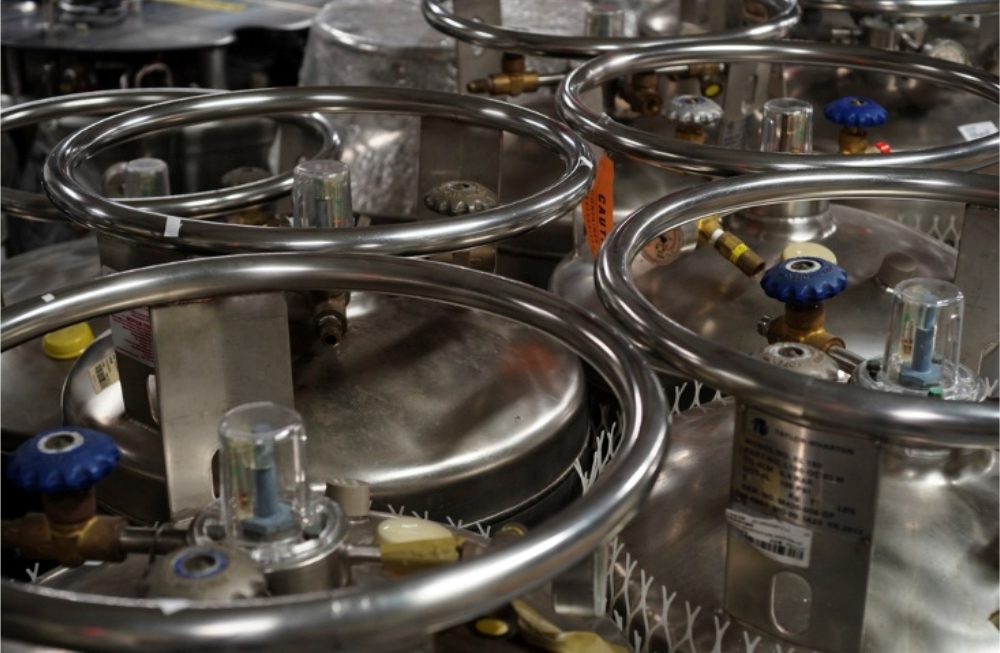
The industrial gas sector continues to see advancements in delivery of cryogenic gases that focus on enhancing safety and improving efficiency. As an example, over the last 1-2 decades, incremental and step-change improvement of telemetry devices has led to increased accuracy and prediction of when a customer will need a resupply, led to more efficient delivery schedules with virtually no customer interaction needed. Premier Cryogenics Services (PCS) based in La Porte, Texas, with additional locations in Slidell, Louisiana, and Delphi, Indiana, would say similar levels of innovation are occurring on the transport equipment side as well. “Our focus is on quality and service value that the Morreale family has always been known for,” states Joe Morreale Co-Founder and COO of PCS. “Innovative solutions are a big part of the service value we deliver.” Clearly, there is the continuing trend of finding more ways (innovatively) to carry more product on every vehicle. As an example , the use of stronger and lighter metal alloys such as 201LN to reduce/replace 304SS content to maximize payload continues to grow. Specific to Microbulk vehicles, suppliers desire increased flexibility to handle a variety of end customers, who are using a variety of storage solutions (i.e., liquid cylinders, microbulks, small bulk tanks)…ultimately creating “multipurpose” vehicles.

© Premier Cryogenic Services
Premier Cryogenics Systems recently introduced its newest Micro-bulk/Bulk Cryogenic Delivery System. This “6th generation” delivery system adds flexibility and dependable reliability to this class of vehicles. It can be configured to handle LIN, LOX and LAR products, and it contains a few innovative features.
The vehicle utilizes a two-hose system allowing you to fill both liquid cylinders, microbulk vessels or atmospheric dewars with a 3/4” diameter hose, and Bulk tanks with the 1-1/2” hose. Operation is straightforward with the operator simply opening the Recirculation By-Pass ball valve when filling microbulk vessels and closing it when filling bulk tanks. The system uses a hydraulic driven cryogenic pump that can achieve metered flow rates up to 130 GPM, and discharge pressures as high as 500 psi (for LIN, LOX and LAR) for filling small bulk tanks, while also able to deliver lower flow rates (10 to 30 GPM) which are needed for filling Microbulk containers or liquid cylinders. A rugged, weather-proof, shock-resistant Advanced Mobile Machine Management Controller (not a PLC), designed for mobile oilfield applications, is used to control the Auto-Stop Fill function (Perma-Cyl® and Express-Fill microbulk tanks) and pump speed control only. PCS also offers a similar cryogenic delivery solution for dispensing LCO2 for BevCarb cylinders, microbulks and small bulk tanks as well.
At the end of the day our solutions must be both safe, user friendly and make our customers more productive,” states Mark Morreale, Co-Founder and CEO, Premier Cryogenics Services. “This is the same innovative approach we bring not only to our traditional LIN, LOX, LAR and LCO2 portfolio, but to LNG, Ethane, Ethylene, Hydrogen and other gases as well.
Green Hydrogen
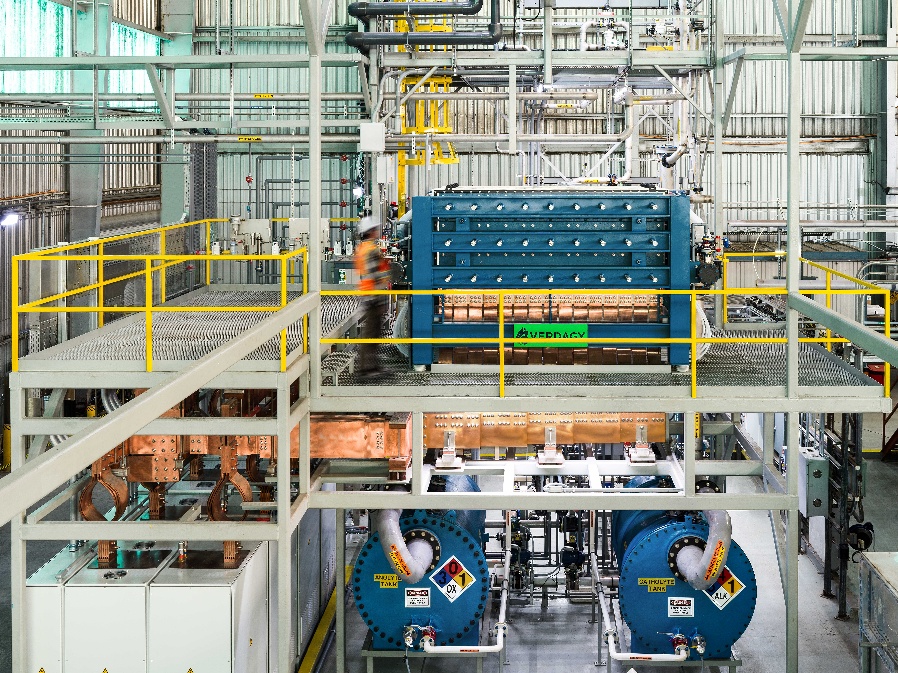
Although there appears to be some “softening” in the near term green hydrogen market, there is still plenty of innovation happening to help improve its economics. Verdagy Inc. based in Moss Landing, California, is one of those companies helping to drive that improvement. It develops and manufactures advanced electrolysis systems for large-scale production of green hydrogen. Neither proton exchange membrane (PEM) electrolyzers or traditional alkaline water electrolyzers (AWE) are ideally suited to cost effectively and safely scale up hydrogen production. However, Verdagy’s eDynamic® AWE system is a breakthrough technology drawing upon decades of successful chlor-alkali electrolysis experience and innovated to more effectively capitalize on the challenges associated with renewable energy sources.
© Verdagy Inc.
Verdagy designed and optimized its refinery-grade, Dynamic AWE eDynamic electrolyzers for industrial scale applications in demanding applications like oil refining, ammonia and methanol production, transportation and steel production. Their electrolyzers operate at the highest current densities and hydrogen production rates of any alkaline electrolyzers. Moreover, eDynamic electrolyzers operate across a wide dynamic range, enabling real-time load matching to intermittent energy sources such as renewables and economic optimization across fluctuating electrical grid prices in order to maximize asset utilization and return on investment.
Verdagy’s design completely eliminates stack replacements and dramatically reduces operating costs through the use of electrolytic cells that have lifetimes of over 20 years, offering the lowest installation costs and commissioning times because of their modular designs. In summary, Dynamic AWE electrolyzers can be characterized as combining the reliability, robustness and low-cost materials of construction of traditional AWE systems with the fast responsiveness and wider dynamic range of PEM systems, while designing out the disadvantages of both.
Verdagy’s eDynamic™ platform was designed from the ground up to meet the demands of today,” states Tom McWaid, Ph.D., Chief Technology Officer of Verdagy. “Industrial-scale, high current density operations, flexibility, speed, responsiveness and the ability to optimize the use of intermittent renewable energy sources.
Outlook
The above examples are but a snapshot of the innovation “in-process” within the industry. Going forward, one can expect the speed of innovation to continue to not only increase but accelerate as enabling technologies such as Agentic AI (and a host of others) take root, helping us to prepare for a world where knowing when and how to use AI (and other tools) matters more than avoiding them entirely.